 how-to
How to Make Soy Candles Smell Better
Last Updated: October 25, 2026
Quick Summary
Soy candles smell better because soy wax has a lower melting point than paraffin, creating a slower, more even melt pool that releases fragrance gradually throughout the burn instead of burning off quickly. Plant-based soy wax also holds fragrance oils more evenly distributed, maintaining consistent scent throw from beginning to end rather than releasing fragrance in bursts like paraffin.
- Fragrance load for soy candles should be 9-10% by weight to maximize scent throw safely.
- Proper wick sizing creates a burn temperature of 180-190°F for steady fragrance release.
- Cold throw is the scent from unlit candles, while hot throw is the scent released during burning.
- Let candles burn 2-3 hours for full melt pool to prevent tunneling and maximize fragrance release.
- Trim wicks to about 1/4 inch before each burn to improve scent throw and prevent excessive heat.
Table of Contents
- Why Soy Candles Smell Better Than Paraffin
- Understanding Soy Candle Scent Throw
- Why Soy Candles Smell Weak and How to Fix It
- How to Make Soy Candles Smell Stronger
- Soy Wax vs. Paraffin: A Fair Scent Comparison
- Maximizing Candle Performance at Home
- Choosing Artisanal Soy Candles That Deliver
- Frequently Asked Questions
Why Soy Candles Smell Better Than Paraffin
Soy candles have become the preferred choice for people who care about how their home smells. But the real question isn't whether soy candles smell better, it's understanding why they perform differently. The difference comes down to how each wax type holds and releases scent.
Soy wax is plant-based and has a lower melting point than paraffin. This matters because fragrance oils blend differently with each wax. Soy wax creates a slower, more even melt pool. That means fragrance releases gradually throughout the candle's burn.
The structure of soy wax also affects how scent molecules travel. Plant-based waxes hold fragrance oils more evenly distributed throughout. Paraffin tends to release fragrance in bursts. Over time, many people notice paraffin candles smell strong at first, then fade rapidly.
Understanding Soy Candle Scent Throw
Scent throw is how far and how strong a candle's fragrance travels through a room. It's the single most important factor in whether a candle actually smells good to you. Many people confuse scent throw with fragrance quality. They're different things. A candle can have high-quality fragrance but poor scent throw. It can also have strong scent throw but cheap-smelling fragrance.
Soy candles typically offer moderate to strong scent throw when made correctly. The plant-based wax releases fragrance steadily as it melts. This creates consistent scent distribution rather than overwhelming bursts. Most people find this more pleasant than sudden spikes of smell.
Several factors influence how well a soy candle throws scent:
- Wax quality, Higher-quality soy wax holds fragrance more evenly
- Fragrance load, How much fragrance oil is mixed into the wax (more isn't always better)
- Wick size, Affects burn temperature and how much wax melts
- Room size, Larger rooms need stronger scent throw to fill the space
- Burn time, Longer burns allow more fragrance to release
Hot Throw vs. Cold Throw Performance
Two different measurements describe how candles smell. Understanding both helps you choose candles that work for your space.
Hot throw is the scent you smell when the candle is burning. It depends on how much fragrance releases as the wax melts.
Soy candles often have better cold throw than paraffin. The wax itself holds fragrance more visibly. You can smell a quality soy candle before you light it.
Hot throw varies more depending on how the candle is made. A poorly formulated soy candle might have great cold throw but weak hot throw. This happens when the fragrance load is too high or the wick size is wrong.
Why Soy Candles Smell Weak and How to Fix It
Weak-smelling soy candles are frustrating. You bought a candle that smelled amazing in the store. Light it at home and the scent barely fills one room. This is one of the most common complaints people have.
The problem usually isn't the wax itself. It's how the candle was made. Several mistakes create weak scent in soy candles:
- Fragrance load too low, Not enough scent oil mixed into the wax
- Wick too small, Candle doesn't reach proper burn temperature
- Candle not cured, Newly made candles haven't fully set and developed scent
- Room too large, The candle's scent throw can't fill the space
- Burn time too short, Fragrance needs time to release into the air
The good news is that most of these issues have solutions. If you own a weak-smelling soy candle, you can improve its performance. Sometimes it's as simple as letting it burn longer or moving it to a smaller room.
How to Make Soy Candles Smell Stronger
If you're making your own soy candles or want to improve store-bought ones, several strategies boost scent strength. Get started with a home candle making kit to practice these techniques yourself. The most direct approach is adjusting how much fragrance oil you add to the wax.
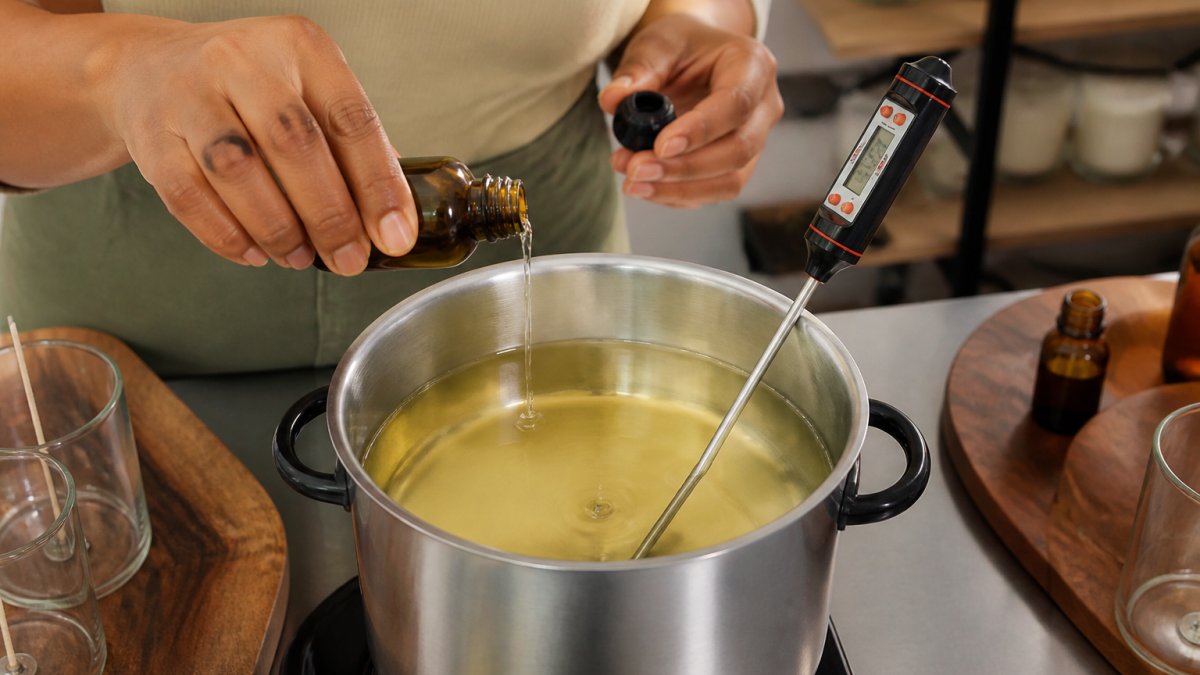
Start by understanding the relationship between wax and fragrance. More fragrance doesn't always mean stronger scent. There's a limit to how much fragrance oil soy wax can hold. Exceeding this limit causes problems.
Practical steps to strengthen scent:
- Increase burn time, Let the candle burn longer each session so more fragrance releases
- Use a larger wick, A bigger wick creates a larger melt pool and hotter burn temperature
- Choose quality fragrance oils, Some fragrance oils have better scent throw than others
- Place candles strategically, Put them in central locations where air naturally circulates
- Ensure proper curing, If you make candles, let them cure for 24-48 hours before burning
Fragrance Load and Safe Formulation
Fragrance load is the percentage of fragrance oil mixed into melted wax. For soy candles, the safe range is typically 8-10% by weight. This means if you have 10 ounces of wax, you'd add 0.8 to 1 ounce of fragrance oil.
Going above 10% fragrance load creates several problems:
- Fragrance doesn't blend evenly into the wax
- The candle may not burn properly
- Scent throw actually decreases because the wax can't hold the fragrance
- The candle may tunnel (burn down the middle only)
- Excess fragrance can cause the candle to sweat or weep oil
Many people assume stronger scent comes from more fragrance. In reality, there's a sweet spot. The right fragrance load for your soy candles is usually 9-10%. This maximizes scent throw while keeping the candle safe and functional.
If you're buying candles rather than making them, look for brands that specify their fragrance load. Reputable candle makers know this matters and will tell you. This is one way to spot quality soy candles.
Wick Size and Burn Temperature
The wick size determines how hot the candle burns. Burn temperature directly affects fragrance release. A wick that's too small creates a cool burn. The wax doesn't melt fully.
The right wick size depends on your candle's diameter. A 3-inch candle needs a different wick than a 4-inch candle.
When the wick is properly sized:
- The melt pool reaches the edges of the container (full melt pool)
- Burn temperature stays between 180-190°F
- Fragrance releases steadily throughout the burn
- The candle burns evenly without tunneling
A wick that's too large burns too hot. The wax melts too quickly. Fragrance burns off instead of diffusing. You get a strong scent immediately, then it fades fast.
If you're buying candles, look for ones that have a full melt pool within the first hour of burning. This signals proper wick sizing.
The safe fragrance load range for soy candles is critical to achieving strong, consistent scent.
| Factor | Safe Range | Effect of Exceeding |
|---|---|---|
| Fragrance load | 8-10% by weight | Fragrance doesn't blend evenly, candle may tunnel |
| Optimal fragrance load | 9-10% | Maximizes scent throw while keeping candle safe |
| Burn temperature | 180-190°F | Fragrance releases steadily without burning off |
| Wick trim length | About 1/4 inch | Prevents excessive heat and soot production |
Soy Wax vs. Paraffin: A Fair Scent Comparison
The debate between soy and paraffin candles often gets emotional. People have strong preferences. Let's look at what the actual differences are.
Soy wax advantages:
- Slower, more even burn
- Better cold throw (smells good unlit)
- Plant-based and renewable
- Cleaner burning with less soot
- Better fragrance retention over time
Soy wax drawbacks:
- More expensive than paraffin
- Requires precise fragrance load and wick sizing
- Can be prone to frosting (white coating on surface)
- Softer wax that's more temperature-sensitive
Paraffin wax advantages:
- Less expensive
- Holds color better
- More forgiving to work with
- Faster scent throw initially
Paraffin wax drawbacks:
- Burns faster and hotter
- Scent throw fades more quickly
- Produces more soot
- Petroleum-based (not renewable)
- Fragrance doesn't last as long in the candle
The honest answer is that soy candles can smell better than paraffin. Explore the differences between natural and synthetic fragrance options to deepen your understanding of candle scents. But only if they're made well. A poorly made soy candle will smell worse than a well-made paraffin candle. The wax type matters less than formulation, wick sizing, and fragrance quality.
For people who want steady, long-lasting scent, soy usually wins. For people who want immediate, strong fragrance and don't mind it fading, paraffin might work fine. It depends on what you actually want from a candle.
Maximizing Candle Performance at Home
Once you have a quality soy candle, how you use it matters. Several habits make candles smell stronger and last longer.
Burn duration matters. Let your candle burn long enough for the entire top layer to melt. Learn how to properly burn soy candles to maximize their scent performance.
Placement affects scent distribution. Put candles in central locations where air naturally moves. Avoid placing them near windows, fans, or air vents.
Room size limits scent throw. A single candle can't fill a large open space. If your candle smells weak, try moving it to a smaller room first.
Trim the wick regularly. A wick that's too long creates excessive heat. It burns fragrance too quickly and produces more soot. Trim wicks to about 1/4 inch before each burn.
Avoid relighting too soon. If you blow out a candle, wait at least 2 hours before relighting. The wax needs time to cool and reset. Relighting too soon can cause tunneling and uneven burning.
Choosing Artisanal Soy Candles That Deliver
When shopping for soy candles, certain signs indicate quality and strong scent performance.
Check the cold throw. Open the candle and smell it before buying.
Examine the wick. Quality candles use wicks made from natural fibers like cotton or paper. Avoid candles with metal-core wicks.
Check for quality indicators. Good soy candles have smooth, even surfaces.
Read reviews about scent throw. Customer reviews often mention whether a candle actually fills a room or just smells good nearby.
Consider the brand's commitment to craft. Artisanal candle makers care about details. You can attend a hands-on candle making session to learn directly how quality candles are created.
When you understand what makes soy candles smell better, you can shop smarter.
The best soy candles combine quality wax, proper fragrance load, correct wick sizing, and careful formulation.
Strong-smelling soy candles transform how your home feels.
Frequently Asked Questions
Why do soy candles smell better than paraffin candles?
Soy wax holds fragrance oil more effectively than paraffin because of its plant-based composition and lower melting point. This allows soy candles to release fragrance at a slower, more controlled rate. Soy also produces less soot when burning, which can interfere with scent perception. However, scent strength depends more on fragrance load, wick size, and burn temperature than on wax type alone. A poorly formulated soy candle may smell weaker than a well-made paraffin candle.
Do soy candles have stronger scent throw than paraffin candles?
Not automatically. Scent throw depends on fragrance load, wick size, melt pool size, and room size, not the wax type. A soy candle with 6% fragrance oil and a small wick may have weak scent throw, while a paraffin candle with 10% fragrance oil and a larger wick will smell stronger. Soy wax does allow for better fragrance retention over time, meaning the scent lasts longer during the candle's lifespan, but initial throw is about formulation, not material.
Why does my soy candle smell weak when it is burning?
Weak scent throw usually comes from a fragrance load that is too low (below 5%), a wick that is too small to create a full melt pool, or insufficient curing time before burning. Room size also matters: a small wick in a large room will seem weak. If your candle smells strong when cold but weak when burning, the issue is likely wick size or melt pool depth. Try burning the candle longer to establish a full melt pool.
How can I make a soy candle smell stronger?
Burn it in a smaller room where scent disperses more easily. If buying artisanal soy candles, look for brands that specify their fragrance load and wick size.