 blog
Natural vs Synthetic Fragrance Candles: A 2026 Guide
Table of Contents
- Natural Candles vs Synthetic Fragrance Candles: What's the Difference
- Essential Oil Candles vs Fragrance Oil Candles: Which Lasts Longer
- Natural Candle Ingredients and What Makes Them Different
- Synthetic Fragrance Candle Safety: What You Should Know
- Scent Strength and Throw: Natural vs Synthetic Performance
- How to Choose a Candle That Matches Your Needs
- Conclusion: Making Your Choice Between Natural and Synthetic
- Frequently Asked Questions
Last Updated: October 19, 2026
Natural Candles vs Synthetic Fragrance Candles: What's the Difference
When you're shopping for candles, the choice between natural candles and synthetic fragrance candles can feel overwhelming. Both options fill your space with scent, but they work very differently.
Natural candles typically use essential oils or plant-based fragrance compounds. Synthetic fragrance candles rely on laboratory-created fragrance oils designed to replicate scents.
At Escents of Hue, we focus on creating artisanal candles with carefully selected ingredients. Our approach emphasizes understanding what goes into each candle so you can make informed choices about what you bring into your home.
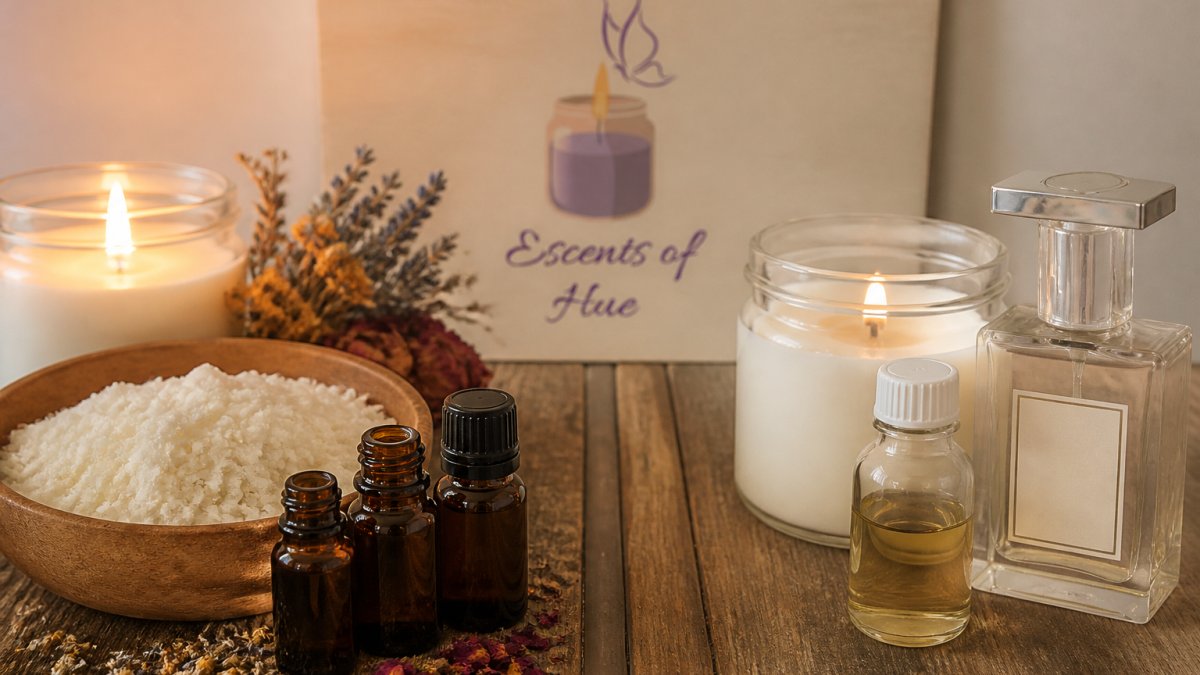
Essential Oil Candles vs Fragrance Oil Candles: Which Lasts Longer
Essential oil candles and fragrance oil candles perform differently when it comes to longevity. This matters because burn time directly affects value, a candle that fades quickly becomes expensive per hour of enjoyment.
Essential oils are extracted directly from plants through distillation or pressing. They contain volatile compounds that evaporate more readily, especially at the higher temperatures inside a burning candle.
Fragrance oils, by contrast, are engineered in laboratories to remain stable at higher temperatures.
The practical reality: fragrance oil candles typically outlast essential oil candles by a significant margin. If longevity is your priority, synthetic fragrance oils deliver more consistent performance.
Natural Candle Ingredients and What Makes Them Different
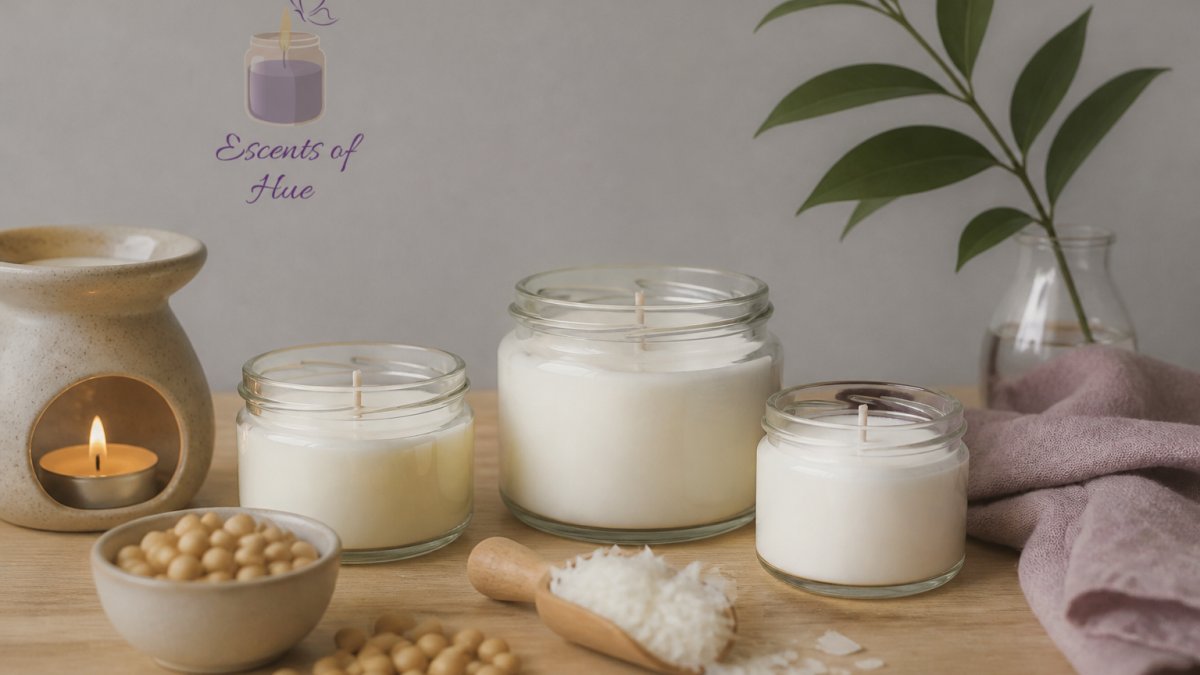
Natural candles start with natural wax bases, soy wax, beeswax, or blended plant waxes, combined with essential oils or natural fragrance extracts.
Soy wax comes from soybean oil and burns cleanly with minimal soot. Beeswax, produced by honeybees, burns longer and releases a subtle honey-like scent naturally.
Natural fragrance compounds in candles come from botanical sources: flower petals, fruit rinds, wood resins, and herbs. These are extracted through steam distillation, cold pressing, or solvent extraction.
What makes natural candles different comes down to transparency and ingredient sourcing. You can trace where the wax originates and identify the specific plants contributing scent.
The trade-off: natural candles often cost more to produce because sourcing quality botanical ingredients requires careful selection.
Synthetic Fragrance Candle Safety: What You Should Know
Safety is the question that drives most natural-vs-synthetic decisions, and it's also where marketing language does the most damage. Before comparing candle types, it helps to separate three labels that are routinely conflated.
Natural describes origin: the ingredient came from a plant, animal, or mineral source. Synthetic describes origin too: the ingredient was made through chemical synthesis. Non-toxic is a safety claim, not an origin claim. None of these three terms is regulated for candles the way "organic" is regulated for food, so a candle labeled "natural" is not automatically safer, and a candle labeled "synthetic" is not automatically harmful. A naturally occurring compound can be an irritant or allergen; a well-formulated synthetic compound can be benign at candle-use levels.
What is actually known about emissions
Any candle, natural or synthetic, produces combustion byproducts when it burns: water vapor, carbon dioxide, and small amounts of carbon monoxide, particulate matter, and volatile organic compounds (VOCs). The variables that most affect emissions are not the fragrance type but the wick, wax, and burn conditions.
The evidence base here is thinner than most articles admit. Indoor-air-quality research on candles is limited, often uses chamber tests that don't match real rooms, and rarely isolates fragrance type from wax and wick. What the research does consistently show is that ventilation and burn practice matter more than the natural/synthetic label.
Allergens and sensitivities
Fragrance sensitivity is real and individual. Both essential oils and synthetic fragrance oils contain known allergens, essential oils are concentrated plant chemistry and can contain allergens such as limonene and linalool, while synthetic fragrance oils may include allergens such as those listed in the fragrance industry's allergen-declaration standards. Neither category is universally hypoallergenic, and no candle should be marketed as such.
Practical guidance: if you have documented fragrance sensitivities, do a short test burn in a well-ventilated room before committing to a full candle, and stop using any candle that produces headache, throat irritation, or coughing.
What to look for on the label
Because candle labeling is not standardized, disclosure is voluntary. Brands that take safety seriously tend to do three things: list wax and wick materials, provide a fragrance ingredient or allergen disclosure on request, and print clear burn instructions. A brand that won't tell you what's in the candle is a bigger safety red flag than whether the fragrance is natural or synthetic.
Consumer product safety guidance on candle use
Scent Strength and Throw: Natural vs Synthetic Performance
Most comparisons of scent throw are not actually comparing fragrance type. They're comparing two different candles, different wax, different wick, different vessel, different room, and attributing the result to "natural vs synthetic." That's a flawed test. To judge fragrance type fairly, you have to hold everything else constant.
Why the two fragrance types behave differently
Essential oils are complex mixtures of volatile plant compounds. Many of the molecules that carry the most recognizable scent notes are small and evaporate quickly, especially at the temperatures found in a burning candle's melt pool. That produces a strong opening scent that can fade as the burn continues. Synthetic fragrance oils are formulated with carrier and fixative materials chosen to release scent more evenly across the burn and to remain stable at higher temperatures. That's why a synthetic fragrance candle often maintains a steadier scent level from first light to last.
Scent throw itself splits into two measurements worth knowing:
- Cold throw, how strongly the unlit candle scents a room. This is driven mostly by fragrance load and how the wax holds it.
- Hot throw, how strongly the candle scents the room while burning. This is driven by melt-pool temperature, wick size, fragrance load, and room conditions.
A candle can have strong cold throw and weak hot throw, or the reverse. Comparing natural and synthetic without specifying which throw you mean produces arguments that never resolve.
A like-for-like test you can run at home
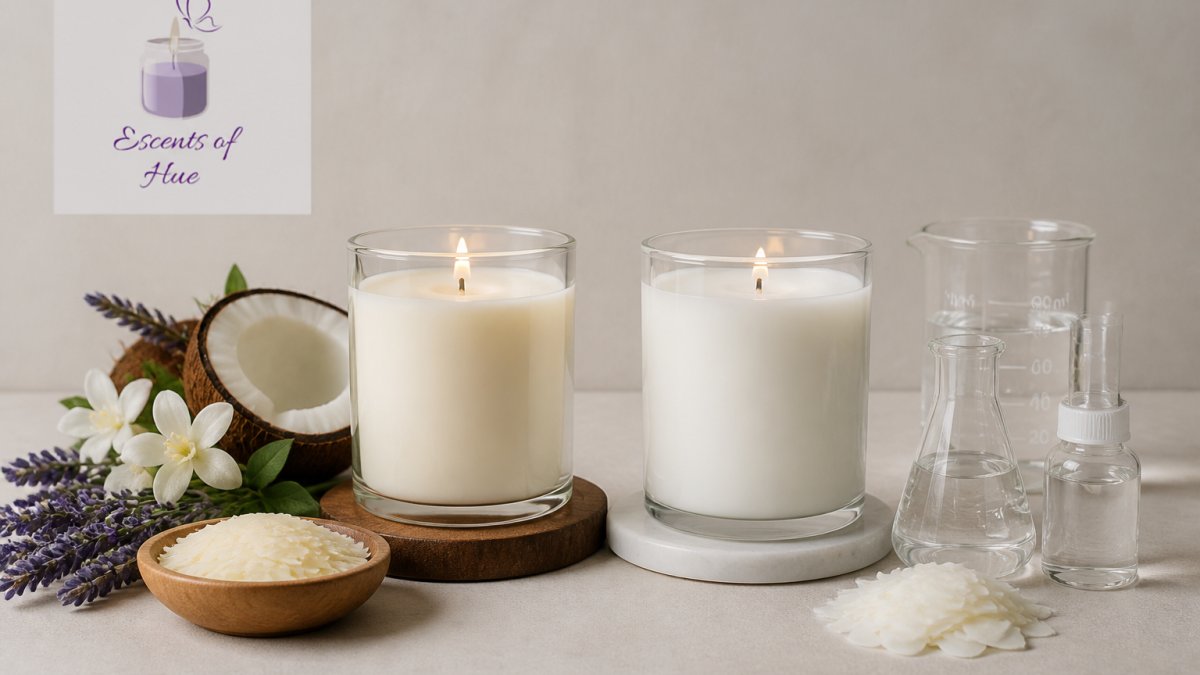
To isolate fragrance type from construction, compare two candles that share the same wax, vessel diameter, wick type and size, and fragrance load percentage, differing only in whether the fragrance is essential-oil-based or synthetic. Then:
- Burn each in the same room, at the same distance from you, with the same ventilation and room temperature.
- Note how long it takes to scent the room (hot throw onset).
- Note how strong the scent is at the midpoint and end of the burn.
- Note whether the scent fades, sharpens, or stays even.
Most people who run this test find the difference is smaller than the marketing suggests, and that wick sizing and fragrance load explain more of the variation than fragrance origin. A well-built essential-oil candle with an appropriately sized wick can outperform a poorly built synthetic candle, and vice versa.
Matching fragrance type to the room
Room size and airflow change the answer more than fragrance type does. A large open living space with high ceilings and moving air will dilute scent from either type; a small bedroom with the door closed will concentrate it. If you want a candle to scent a large room, look first at fragrance load and wick size, then at fragrance type. If you want a subtle ambiance candle for a small space, an essential-oil blend is a reasonable choice, but so is a lightly loaded synthetic candle.
The authenticity trade-off
Essential oils contain hundreds of individual compounds, which is why they can smell layered and complex. Synthetic accords are built from a smaller set of aroma chemicals and can read as flatter or more linear, though modern perfumery has narrowed that gap considerably, and many people prefer the clarity of a well-built synthetic scent. This is a preference, not a performance ranking.
How to Choose a Candle That Matches Your Needs
Start by identifying your priorities. Are you most concerned about scent strength, ingredient transparency, burn time, or allergen concerns?
For scent strength and consistency, synthetic fragrance candles are the practical choice. They perform predictably and maintain fragrance throughout their burn life.
For ingredient sourcing and transparency, natural candles align better with that priority.
If you have fragrance sensitivities, test before buying. Neither natural nor synthetic candles are universally safe for people with sensitivities, it depends on individual reactions.
Consider burn time and value. Calculate cost per hour of burn time, not just the upfront price.
Look for transparency in labeling. Quality candle makers, whether using natural or synthetic fragrances, disclose their ingredients clearly.
At Escents of Hue, we believe the best candle is one that matches your specific needs and values. Our artisanal approach means you can ask questions about sourcing, ingredients, and performance.
Conclusion: Making Your Choice Between Natural and Synthetic
The choice between natural candles and synthetic fragrance candles ultimately depends on what matters most to you. Natural candles offer ingredient transparency, authentic botanical scents, and appeal to people prioritizing sourcing and sustainability. Synthetic fragrance candles deliver stronger scent throw, longer burn times, and more consistent performance.
Neither is objectively "better", they serve different preferences and priorities. Someone seeking a candle to fill a large room with reliable fragrance will be happier with a synthetic option.
The most important factor is choosing a candle from a maker who's transparent about their process and ingredients. Whether natural or synthetic, quality matters. A well-made candle with honest labeling will serve you better than a poorly constructed candle making vague claims.
Frequently Asked Questions
What is the difference between natural and synthetic fragrance candles?
Natural candles use ingredients like soy wax, beeswax, or coconut wax paired with essential oils or plant-based fragrance compounds. Synthetic fragrance candles rely on laboratory-made fragrance oils blended with wax. The key difference lies in sourcing: natural candles come from botanical extraction, while synthetic versions are manufactured in controlled environments. This affects scent authenticity, longevity, burn temperature, and how your home's air quality responds to burning.
Are essential oil candles better than fragrance oil candles?
Essential oil candles offer authenticity and may appeal to those seeking botanical origins, but fragrance oil candles often deliver stronger, more consistent scent throw and longer-lasting performance. Essential oils are volatile and can evaporate quickly during burning, reducing burn time and scent longevity. Fragrance oils are engineered for stability and reliability. Neither is objectively better, it depends on whether you prioritize natural sourcing and subtle fragrance or consistent strength and predictable performance.
Are synthetic fragrance candles safe to burn?
Synthetic fragrance candles are generally safe when burned in well-ventilated spaces and made by reputable manufacturers. However, some people with fragrance sensitivities or asthma may experience headaches or respiratory irritation from synthetic scents. Look for candles made with quality fragrance oils from established suppliers and avoid products with undisclosed ingredients. If you're sensitive to strong synthetic fragrances, test a candle in a small space first, or consider natural alternatives formulated for sensitive individuals.
How can you tell whether a candle uses essential oils or fragrance oils?
Check the product label for ingredient transparency. Candles listing specific essential oils (lavender, eucalyptus, lemon) typically use plant-derived fragrance. Those labeled simply as fragrance oil or perfume oil use synthetic compounds. Natural candle makers often highlight botanical sourcing and provide detailed ingredient lists. If the label is vague or doesn't specify fragrance type, contact the maker directly. Authentic artisanal candles usually disclose their sourcing because it's a key selling point.
At Escents of Hue, we craft artisanal candles with carefully selected soy wax, thoughtfully blended fragrances, and attention to every detail of the candle-making process. Our handcrafted approach means you're getting a product made with intention, not mass-produced on an assembly line. Whether you're drawn to natural ingredients or appreciate the consistency of fragrance oils, we invite you to explore our collection and find the scent that transforms your space into a haven of tranquility.